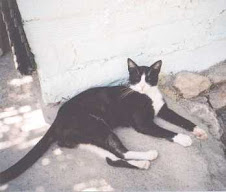
The weather had been cold and wet these last few days in Dalmore, and strange to relate, it was mid July. I suppose it was no better in Shawbost or Bragair, but today it was calm and the sky was blue. Over at No.4, Taigh 'houdie, Iain called a meeting of the resident cats and dogs. Soho, Rupie and Guinness were discomfited at the sound of the word "meeting". "A meeting," mused Stowlia, "this must be serious. Never heard of a meeting in this house before." Murdo could sense their anxiety and tried to reassure them with a smile.
Iain. " Shonnie, over at No.5, wants to discuss a proposition with us, which will also involve the cats and dogs in Taigh Glass".
"O, bhobh( Dear me), a meeting - now a proposition. Whatever next ?" Stowlia had more than a little of the Jeremiah in her, and was uneasy with what she had heard. The rapid movement of her eyebrows betrayed some anxiety, which in turn unsettled the cats. The meeting was convened outside Shonnie's weaving shed, opposite the hen house.
Shonnie. " We were thinking that, weather permitting, all of you might like a sail in my boat tomorrow afternoon, out on the "caolas"(Gael. " estuary, strait") to Loch Roag and the islands off Bernera. It will have to be a very calm day, and we must all behave responsibly while on board. We will have ourselves a picnic on one of the islands, and we may even catch a few fish, for later on."
Any doubts that our wee friends might have harboured were now removed. A general outcry of barks and meowing ensued, partly from relief, but more in excitement at what tomorrow held in store. The cats brushed against Shonnie's and Iain's legs, and Fancy, Stowlia and Jura went barking mad, howling their delight in unison. This, the animals thought, must be the most exciting thing that ever happened to them. Well, to be fair, it isn't often that cats go on a cruise, although dogs have been known to go fishing.
The big day arrived, and the weather was perfect. Well that's what everyone thought - everyone, that is, except Iain Shoudie.
Iain Shoudie. " If one looks out there on Dalmore Bay, the sea appears calm, from here to the far horizon. A good day to go fishing out of Loch Carloway, you might think. That is not always the case. In this village, by tradition, we were told to examine the state of the waves out there at Rudha na Trileachan, the point out there on the far left of the bay ( the Oyster Catcher's Headland). It could be that the sea looks calm, but if the waves are breaking strongly on the rocks at Rudha na Trileachan, then fair weather cannot be guaranteed out on Loch Roag. But, as you can see, things are fairly calm out there, so the sail is on!
It was by good fortune that Shonnie's cat, Tom, decided to come down from the Beinn (hill) on the very day of the boat trip. You will remember that Tom served on His Majesty's ships during the war (Ratter RNR), before retiring to Dalmore as a warrener. Normally a private individual, Tom was persuaded to join the rest of the "crew" aboard SY 92, moored at the Dunan at the head of Loch Carloway.
In case you are wondering, Shonnie's little address to the animals was in fact simultaneously translated by Iain Shoudie for his little friends.
The boat eased itself round the Dunan Pier with Shonnie "at the helm", and with the little outboard on full throttle, the boat gently cut its way through the flat-calm of Loch Carloway. They passed the little village of Doune on the port side, and a few minutes later the deserted hamlet of Laimishader appeared on the opposite shore. Shonnie told them that before the pier at the Dunan was built, the remains of an Iron Age fort occupied the site, built nearly 2000 years ago. The beautiful little village of Laimishader had been occupied until about 100 years ago, and had always been known in Lewis as an early Christian site, where miracles could happen. Long after it was a ruin, and up until more recent times, a mother with her sickly child would shelter in the ruins of the church overnight, hoping her prayers would bring healing to her child. Victoria asked Shonnie if sick puppies and kittens were ever taken there by their mothers. Shonnie noted how earnest was Vicky's question, and with a smile, assured her that it was likely - why not.
A gentle breeze passed over the boat, and occasionally one of the crew would have a fine spray of water lick their face. Fancy was properly attired for this sea voyage, wearing, as he was, his full motorcycle gear - leather pilot's jacket, leather flying helmet and a pair of American aviator goggles. She sat beside her master, Shonnie. He gave Fancy a short "spell at the wheel", but it was difficult, having only "spogs"(paws). Victoria asked Guinness if her blue-cream coat looked OK, what with the wind and the sea spray. " You look smashing, hen", replied Guinness who came from Glasgow. Passing the lighthouse at Aird Laimishader, they were now in the "caolas" proper, where the wind was fresher and the waves a little livlier. Iain Shoudie remarked that the sea was fine, but Jura and Stowlia lay together at the bottom of the boat, feeling a little light-headed.
"We are nearing the island of Little Bernera", said Shonnie. "We will go ashore there to picnic, to look around and to relax." The boat slowed as it passed between rocky spurs to reveal the most delightful little golden beach. This little lagoon was home to a number of Atlantic seals, who started barking at the boat's approach. " Do you dogs understand what the seals are saying?" asked Soho. " But of course," answered Stowlia. " The Big Fella. there on the rock is asking if we know his cousin, Ronnie in Dalbeg Bay." "And do you?" said Soho, with the hint of a Cheshire-like smile on her pretty face. The boat finally beached on the golden sands of little Bernera. To be honest, the wee folk were happy to be back on terra firma, and they enjoyed exploring the island with not so much as a house on it. But there once was a farm and house here.
In fact, said Iain Shoudie, the first Maclennan to arrive on Lewis, was granted the lands of Little Bernera by the overlord of the island, Lord Seaforth, Chief of the Clan Mackenzie.
" And all of the Maclennans on Lewis had their beginnings here, back in around 1700. Murdo and I are descended from that very first Maclennan, the Tacksman of Little Bernera. And before you ask, So-sally, you are descended from the first Maclennan cat on Little Bernera.
" You will have seen the small graveyard above the beach. That used to be resting place of the Carloway people before the cemetery in Dalmore opened in around 1910. The burial party would have to row all the way out here to bury their loved one. If the weather was stormy, and lasted more than three days, then the body was interred in the little cemetery in Cirbhig, across from the Dunan."
"I could listen all day to Iain Shoudie," said Vicky. " He has a way of making the old times come alive."
Tom Warrener had been fairly quiet throughout the day, and Shonnie noticed it. This would be the first time Tom was at sea, since he served along side his friend Shonnie in the Royal Navy at the end of the war. Shonnie invited Tom to sit at the stern with him, recalling the time they served together down in England. Shonnie cradled Old Tom in his arms as they turned for home. The men started fishing with the hand-lines and invited the crew to step forward to assist. They struck lucky almost immediately, and within a short time they had enough for a fry-up. Seoras met them at the Dunan with his van, and transported skipper, bosun and crew back to Dalmore.
This was a day that they would fondly cherish for years to come. Think about it - cats and dogs fishing for haddock. Quite unbelievable !
Sunday, 29 August 2010

Monday, 16 August 2010
The Dogs Have Their Day..
A blue sky, a few wispy clouds, and it was already warm in Dalmore, this early in the morning. A perfect day for it, but in truth wasn't it a perfect day for just about anything . The Dalmore and Dalbeg fank had happily been arranged for this day. Late July was the time when the sheep and lambs were gathered in from the moors, and the people of the villages always made a day of it. An American lady once stopped to ask what was going on, and why it was called a fank ( Gaelic "faing"). She dutifully entered the information in her travel diary and spent some time with Seoras perfecting various Gaelic pronunciations. She maintained that a lexicon of Gaelic pronunciations should be included wherever necessary, if the language was to be "popularised". Seoras said that Gaelic was still popular enough in Lewis.
Back in Dalmore, preparations were being made for the fank, located in an old gravel pit below Cnoc Na Cartach( Carters' hill) on the main road to Stornoway. Bar a few additions, it was "ready made" as a fank. Ropes, sacks, shears and dye sticks were gathered, and the women folk prepared some food for the day. The sheepdogs were indispensable in this undertaking, for as ever, where sheep are being worked, there you will always find dogs possessed of remarkable skills. Victoria, the blue-cream Persian, asked if cats could be of any help at the fank. Iain Shoudie thanked her kindly, but told her that a fank could be a dangerous place for cats, and that it is better that they remained within the village, just for today. Jura the black labrador, like Vicky, home on holiday from Glasgow, could come along, but purely as a spectator, and must not get involved with the sheep under any circumstances. It might prove very tempting, but she must stay well away from the throng of sheep, lambs and sheepdogs. The Shoudie dog, Stowlia, would be at the fank, but she was a sheepdog in name only, and would be better employed chaperoning Jura for the day. Of the three, Fancy was the only dog of any ability around sheep, but even then was in the second division compared to heavyweights like Toss, Sweep or Moss. The success of the massive sheep-drive would be down to those three. Stowlia told Jura that there could be as many as twelve dogs involved, and to note how competitive the men were with their dogs. They determined to get a good view of the men and the working dogs as they gathered the sheep from disparate parts of the moor. "Beinn na Cloiche" (the stony hill), a little way out, stood 525 feet in height, and was perfect for the panoramic view it afforded. Stowlia and Jura watched with excitement, tinged with a little envy, as the men gave their dogs the commands that sent them on the long outrun. These were a mixture of Gaelic, English and whistles - "Mach a' seo", "Way out" and some more. They had a large area to cover; as far out as Beinn Bhragair, Loch Raoinabhat and Beinn Horshader. The dogs were so far out, that they now had to depend on instinct, each working in concert with the others. They would collect stray groups of sheep to add to the drive, and working back and forward, this huge bleating mass was inexorably moving in the direction of the fank, where their masters would take over command for the close quarter work with their dogs. Jura, that gentle dog, whose normal daily exercise was a forty five minute stroll in the local woods, was standing on the high vantage point of "Beinn na Cloiche", in awe of the scene before her. Hundreds of sheep and lambs now driven together, uttered a continuous cry, as the more skilled dogs worked back and forward, right and left, helping to shepherd this massive flock through the entrance of the fank. This was a crucial time, when the most determined sheep were wont to break away. Other than Jura and the Shoudies, I wondered who else noticed dear old Stowlia running about at the rear of the other dogs, making out that she too had a contribution to make. She now felt like a real sheepdog, and the wink from Iain Shoudie meant so much to her. Actually, the top dogs like Sweep and Toss could always expect a late foray from Stowlia, but they were happy to oblige her in this yearly flight of fancy. Talking of Fancy, she had acquitted herself well, according to her peers, and Shonnie her master was best pleased with her performance. The fank got under way as the men slowly made their way through this large body of sheep, identifying their own, and passing them out to be tied and sheared. Lambs were set aside to be returned to Dalmore. There was much banter and laughter around the fank, and a little beer and whisky was at hand to slake the driest of throats . Some food was taken, sacks bulged with newly shorn wool and the animals were finally released to be driven towards Dalmore, where the sheep and the lambs were parted, and the lambs brought inside the village fence. The constant bleating of the lambs and the response of their mothers would fill the valley for days to come. Only the hardest heart could fail to be touched by their cries.
As we now know, cats don't go to fanks, nor do they mix with sheep - not as a rule. But we are aware that there may be "exceptions to the rule". Among the lambs which came back to the Shoudie house, was a tiny blackface, who had either been rejected by its mother, or the mother had recently died. Iain and Murdo started bottle feeding right away. The cats took this wee lamb to their hearts, and in time this small soul started to follow Soho, Rupie and Victoria about the croft. Stowlia the dog could only marvel as the cats gambolled with "Eobhann an Uan" ( Ewan the Lamb), its name the product of Iain Shoudie's fertile imagination. On cold wet days, Ewan would join Kenny Iceland and the others at the fireside, courtesy of the Boys. A lamb warming itself at an open fire - unbelievable, I know, I know.
Friday, 6 August 2010
Heroes of the Airidh (shealing).
Iain Shoudie rose from the "being" (bench) after a refreshing "norrag" ( like forty winks, but much shorter ). Using the tongs, a relic of the Iron Age, Iain rearranged the glowing embers of the fire, and strategically placed a few peats on top, with the know-how of the seasoned Gael. He managed this despite the presence of various domestic animals around his feet, pets who were settled "ri taobh an theine" ( at the fireside). It would be around nine in the evening, and soon Murdo (John's brother) would arrive with the two Galloway cows that had grazed all day in the hills over towards Dalbeg. So-sally, Rupie and Stowlia could hear Murdo opening and closing the gate to the croft up at the back of the house. O Man, what a sight as those two majestic black creatures negotiated the doorway to the house, turning left to occupy their own stall in the byre. With the cows tethered to the wall, Murdo was usually the one who did the milking ( a gentle touch, soft comforting words). Those gentle cows would give two large enamel pailfuls of premium milk. There was no skimming, no pasteurising and for a while no tuberculin testing. There was plenty of milk to go around and Soho(aka So-sally), Rupie and Stowlia waited around the byre, with the odd meow from the cats. Murdo would assure them that milking was near an end, and in time they all had their bowl or saucer full of that rich warm milk. Murdo and Iain had some supper - bully beef and some water waffers (Jacob's Cream Crackers) and they were all settling to a quiet evening when "dithis Glass" arrived from over the way. Fancy, the collie, and his friend, Filax, the cat were made welcome at the warm fireside, just as Iain got the Tilley lamp going. This had the makiings of a good "taigh ceilidh", and there was an air of expectation among the animals. Stowlia, the house dog, looked squarely at Murdo, moving his eyebrows up and down, knowing how this rarely failed to take a trick with the boys. "Murchadh, innis 'inn 'storrie'. " (Stowlia had asked Murdo for a story), Murdo being the better "seanachaidh"(story teller) of the two Maclennan men.
Iain Shoudie smiled as Murdo lay his book down on the dresser, and on top he placed his bendy wire spegligans. Murdo adopted a serious demeanour as he returned Stowlia's stare. Stowlia waited a moment before again doing her eyebrows thing. It never failed. A smile began to break over Old Murdo's face, and he was as good as "hyooked", as Iain would say.
"Am math leat mise a-dheanadh so ? ("Do you want me to do this?")
There was a chorus of barking and meowing, whose meaning was unequivocal. Murdo stirred the peat fire, and its yellow glow lit up the faces of his expectant wee friends. Murdo began his tale of a time past.
Murdo : " You may know, or perhaps not, that our people in the Highlands and Islands. a long time ago, fought for the right to own a few acres of land, where they could build a house for their families, and grow a few crops. They would no longer fear the heartlessness of the landlords, under whom they were mere serfs. Now they could tend their crofts without interference, but there were still a few conditions attached. An important part of the Crofters' Act was the requirement that each summer for a period of six weeks, all animals, mainly cattle, were removed from the crofts to allow the grazings to recover. Crofts of approximately four acres needed a period of regrowth to protect the valuable grasslands. All the cattle were herded onto the adjacent moorland and it is here that generations of people lived out their summers at the "airidhean", the shealings, so dear to the hearts of successive Lewis families.
The father, grandparents and some children would remain behind on the croft to look after the crops, and perhaps to do some essential repairs about the place. The mother and the rest of her children would travel out to their own "airidh", basically a small bothy of stones and turf to afford shelter from the rain and the winds, and where they could lay their heads at night. Out there on the airidh, the prime concern was the welfare of the cattle, a precious and expensive asset at any time. It would usually fall to the children to tend the cows, moving them to the best pastures and ensuring that they were kept away from other cattle with whom they might fight. This is known as "buachailleachd", the herding of cattle, a very important responsibility it was.
"Now, my little friends", said Murdo, " this story will be of particular interest to Fancy and Filax since it involved the Glass family from Gearrannan while at their airidh at Tom Liabhrat. The shealing was about a mile south-east of the Dalmore road end, and was located on a small grassy knoll overlooking Loch Tom Liabhrat, a small lochan. Shealings were usually grouped together in small moorland hamlets of people from the same village. Most of the normal activities of the croft were engaged in here, but to a lesser degree. The cooking, baking, milking and washing were carried out in the open, when the weather was fine. There was much to-ing and fro-ing between the croft house in Gearrannan and the airidh at Tom Liabhrat. Milk and bread were taken back to the people at home, while peats, flour and other essentials made their way to "Airidh Glass". At the airidhean, lifelong friendships were forged here, and romantic trysts might one day end in marriage . Children were born at the airidh, sometimes people even died here. People went visiting their neighbours to ceilidh or perhaps just for a "strupag" (drop of tea). There were banks of blaeberries where the children would sit for hours picking the tiny black berries, sweet and laden with colour. When the sun went down and the oil lamps began to be lit in the airidhean, this was truly a wonderful sight, so far out on the lonely moor.
There were many new sights and sounds out here. There were peat workings abandoned long ago with tall towers of turf and heather isolated on the soft floor of peat. For the children of the shealings, this was a magic land inhabited by the "little people" ( Ni sithiche ). The cry of the corncrake and the lapwing were ever present. There were a few lochs in the area other than Loch Tom Liabhrat around which many of the Gearrannan airidhean had been built. Its waters were shallow and it was deemed safe for the children to play in, with so many eyes on them. The little loch provided water for drinking and washing. You couldn't ask for a better site for the shealings.
There were one or two bigger lochs in the vicinity, Feath Loch Gleaharan ( "Feath" Gael. dead calm.) being no more than half a mile distant. One hot summer afternoon, two young children, Calum Macleod and his sister Catriona, aged four and six respectively, had made their way to Gleaharan, and were feeling hot and tired. Against all the warnings that had been given, they decided to cool off in the cold waters of the loch, venturing out until the water was waist high. They were happy cavorting and splashing each other with water. If you only have two legs, these moorland lochs can be very dangerous, what with the cold water, the bottom currents, algae covered stones and all types of plant growth. Nearby, Glass's dog Glen and his pal, Shoudie's Clyde were trying to free some rabbits from their underground homes when they heard a girl's cry for help. Catriona and Calum had lost their footing, but while the little girl had regained her footing, her brother Calum was being carried out into the loch beyond her reach. Just at that, Glen and Clyde were by Catriona's side, who pointed frantically towards her brother, now about thirty yards out and his head barely above the water. Glen,who thankfully had all of four legs, plunged into the loch and swam straight for Calum. Holding onto this dear dog's back, Calum was soon safely on the shore with his sister, with whom Clyde had stayed throughout the rescue. Apart from a little spluttering and shivering, the children were safely back in the bosom of their family. Needless to say, our four-legged friends were feted as heroes.
"If this heroic act had taken place now," said Murdo, " then Glen (and possibly Clyde) would have been given the Dickin Medal, the highest award for animal bravery, the equivalent of our Victoria Cross.
" Well, my friends, I hope you enjoyed the story, but it is now bedtime," said Murdo. Actually, Iain Shoudie was already fast asleep up in the room, and one or two of the wee folk were nodding off in front of the fire, beside their pal, Murdo.
Sunday, 11 July 2010
Eaglais nan Eoin ( The Birds' Church )
I think we would agree that almost everywhere, there are many more birds than cats and dogs. The West Side of the Island of Lewis is no exception. The religious fervour of the birds in these parts has long been talked of, and many would say that their devotions even exceed those of Eaglais a' Choin s' Chait, the Dog and Cat Church in Doune, in charge of which is the Right Reverend MacCollie, the minister who is very attached to his collar. Eaglais nan Eoin was situated in the village of Shawbost, which could accommodate large numbers of birds, which flocked to the various Sunday services. They had acquired a large barn of a place in Fibhig, an enormous shed no longer used by the local Harris Tweed mill. Beams and shelving used previously in the mill afforded ideal pews(perches,really) for the large congregations that foregathered there every Sunday. The birds liked their Calvinism dour and unadulterated, and this was reflected in a succession of old time avian ministers. Predestination and damnation were favourite themes of these preachers, and favourites too of the congregations. Such were the numbers who came to the Shawbost Church at Fibhig, that multiple meetings of perhaps one thousand birds were required to service this multitude. The Avian Free Church had the largest congregation on the island, by far. Every bird from the wren to the raven attended these popular services, and all were seated in the "pews" according to size. There were always a large presence of the crow family (carrion crow, rooks etc.) and, as one would expect, a great variety of seabirds, especially gulls. There were lapwings,sparrows,blackbirds, and, up high at the rear of the church, a bevy of buzzards fresh in from the creeks. There was a loft( not an organ loft, mind, you) high above the pulpit which was reserved for a particular church member who commanded a lot of respect from others, if not a little fear. This was Gilleasbuig, the golden eagle, who would fly in from Beinn Bhragair to attend these services. Before the Reformation, Gilleasbuig might well have been proud to mention that he was descended from a long line of bishops, but this was something he never spoke of now, and to be sure, neither did anyone else. Gilleasbuig was definitely a presence in the church and he ruffled a few feathers, so to speak, when he flew in to take his pew in the loft. On the few occasions that Gilleasbuig's wife could be persuaded to come (she was not of his persuasion), they said that it was as though the Holy Ghost had passed through the church. The "eoin oig" ( young birds ) were always well behaved when Gilleasbuig Mor was in church. His eagle eye could take in the whole congregation without so much as turning his head. The young birds looked straight ahead, wings folded, and not a chirp or a peep from anyone. He was a godsend to the minister and the elders.
The minister of Shawbost Avian Free Church was renowned as a great preacher, and was very often asked to "guest" at other churches throughout the Hebrides. He was not large of stature, but his presence always dominated any company he was in. A carrion crow born in Stornoway, the Reverend Kenneth MacCraw was said to be the "most powerful" preacher ever heard in the Isles. He was known by all as "MacCraw Mor", whose powerful message could bring tears to the eyes of the hardest-bitten buzzard. During the communions, a few years back in the Ness Church, it was said that a number of herring gulls had collapsed with the fervour of his preaching, and later became communicants of the church. MacCraw Mor took most of his lessons from the Old Testament, which he felt best reflected the time and travails of his people, much like the Children of Israel long ago. Some people aver that the Celtic peoples are descended from the "lost tribe of Israel". The Reverend MacCraw had no doubts about this.
With their souls well nourished, the large congregations would disperse, each bird returning to its own habitat. For Big Gilleasbuig, the golden eagle high up in the loft, an exit strategy had been devised to save the big fella' and the church from damage, as he took his leave back to Beinn Bhragair.
In Dalmore, Iain Shoudie was always abreast of matters, and with regards to the events above, his "coilleach",Calum and Calum's wife the "cearc", Fiona were regulars at the Shawbost Church. Iain Shoudie, as you know, could talk to the animals, and it was he who told me this story. If it were possible, I would loved to have heard MacCraw Mor in full flight, no pun intended.
Gael. "coilleach" Eng. cockerel
Gael. "cearc" Eng. hen
Gael. Gilleasbuig Eng. Archibald - literally "the follower of the bishop"
Gael MacCraw Mor Eng. Big MacCrow
Monday, 26 October 2009
Tom Warrener Comes to the Rescue.
Vicky, the beautiful Persian cat, and her grown daughter Tigger, were, you remember, the city cats staying with their cousins at Taigh Glass at No. 5 Dalmore. Knowing their way around a bit better, they decided to explore the hills above the house on their own - neither Filax nor the dogs Fancy and Jura would be with them. Vicky said that they could move faster, and see more without the solicitations of Jura their "guardian", who would always caution them to be careful, and not take any risks. Well, thought Vicky, how utterly boring life would be if all you cared about was avoiding risk. Jura was a lovely dear, but could be a teeny bit conservative.
They had heard people say that the quickest way to the top of Beinn Dhala Mor was through that long passage called Sgorr Domhnall Duncan, which comprised an enormous split in the rock above Taigh Glass. Goodness, they thought, what a dreadful place. It was dark, cold and damp in the passage, and everything was covered in wet moss or lichen. It was difficult to maintain ones balance, the floor being so slippery. After a few spills in that hell-hole, they eventually emerged into the fresh air at the top of the Beinn. Tigger resolved never to take that short-cut again, and both wondered why Donald Duncan, the shepherd in times past, had chosen this awful place to say his prayers. Vicky and Tigger jumped from stone to stone to cross the Allt Garbh, which that morning did not live up to its name (fierce river), and climbed further to Beinn Bhrag, the highest point of these hills. ( Gael. 'brag' Eng. herd of deer). Deer? - not for a long time. There is another place in Dalmore with a 'deer name' called "Cnoc na Fheidh", (hillock of the deer) beside the east side of Loch Langavat. So, in times past, there were certainly deer here in Dalmore. The view from Beinn Bhrag was magnificent, the more so because our cats were city born and bred. Tigger and her mum rested here for a while, less through tiredness, more in appreciation of the vista before them. From this very spot they could see lochs, rivers, hills, sea cliffs and two beautiful beaches. As they sat there they became aware of a large bird circling high above them, making high pitched cries which left them feeling uneasy. This was no blackbird nor finch which they often hunted around the neat hedgerows, back in suburbia. This was a huge bird which came ever closer each time it swept past them. Vicky and Tigger came to the same conclusion and at the same time. Here was a giant raptor which was capable of taking and killing either one or both of them. This was not a raven or a hawk, and they decided to move away quietly and hide from this fearful bird. It was only later that Iain Shoudie told them that what they had witnessed was a golden eagle over in the Ghearraidh, where it often builds its huge eyrie. The golden eagle is the largest bird of prey in Britain.
Later, they made their way out the beinn, until the big bird dropped out of sight. Here, Tigger decided to climb down from the Beinn and explore the hill opposite, Cnoc a' Choin (The hill of the dogs). She did not expect to meet any, but what a strange name for a hill, in the back of beyond ! Below the hill on the other side was a slow flowing "allt" (stream), and on it what had been a building erected a long time ago. There were two large granite stones still in place, and later she was to learn that this was a corn mill used by the old people of Garenin in times past. Tigger spent some time here on Allt na Muilne ( The River of the Mills), only to realise that she hadn't heard from Vicky for some time now. She retraced her steps to the point on the Beinn where she last saw her mother. Vicky was not there, nor anywhere else along the length of the hill. She did not respond to Tigger's repeated loud cries, and this began to worry her a lot. At times like this, it is natural to think of worse case scenarios. Up here on Beinn Dhala Mor, home to the giant golden eagle, it was easy to conjure up a dreadful outcome. Then there were mink, ferocious and deadly killers, whom some said had escaped from their "farm". Our beautiful Victoria was in mortal danger, if not found soon.
Tigger returned to Dalmore at great speed, and raised the alarm. Every cat and dog from every house was mobilised, and search parties organised to cover the whole of that side of the village. Many hours were spent on these searches, but to no avail, and darkness was falling fast. If she was still alive, Vicky would have to spend a cold dark night out on the hill alone. At dawn next morning, as the parties were organising that day's search, Kenny Iceland, the rabbit hunter from the other side of the glen, cleared his throat and asked permission to speak. Jura said that this was a democracy, and of course they would all listen to what Coinneach(Kenneth) had to say.
Kenny:" Let's all think now ! Who knows the Beinn and the Gearraidh best of all ? Who virtually spends all their time there, knows every hillock, every peat bog and of course every rabbit warren."
Everyone knew to whom Kenny alluded, but that guy wasn't here.
Filax: " Kenny, we all know whom you mean, but Navy Tom is a bit of a loner, and can be almost impossible to find in the hills. To be sure, if anyone can locate Vicky, Tom is our man. We would have to find him, before we stood a chance of finding Vicky."
Kenny: " Tom and I are in the same game. We are warreners. Tom does one side of the glen, and I do the other. Our hunting techniques are identical and I feel that I could find Tom up there on the Beinn in pretty short time, since time's of the essence."
It didn't take Kenny long to find Big Tom. He emerged from a rabbit hole, his big smiling face covered in sand, looking very much like that cratur Bagpuss we hear the children talk about. The hunt was on, Tom in the vanguard, and the others at a distance behind, so as not to prejudice Tom's amazing sense of smell . After a little time, on top of Beinn Ia' Ruadh, Tom was seen to freeze where he stood, and then made a sort of low strangled call. To the amazement of every one in the search party, they heard a faint call from a cleft in a rock, close by. It was our Victoria, and she was stuck fast between two rocks, with only her tail protruding. She was in a dreadful state, but still in one piece, as far as Tom could make out.
Tom: "Now, Vicky, the only way we're going to get you out is if I get a grip of your tail in my mouth, and someone takes hold of my tail, and we pull together. What do you think, Old Girl ?""
Vicky: "Never mind the "Old Girl", Tom. Do what you have to, but do it quickly and go easy on that gorgeous Persian tail. " Tom had to smile to himself.
Vicky was soon out,and the large group of cats licked our lady clean, well, as clean as a "cat lick" could. Auntie Dolly gave Vicky a proper bath and dried her at the big peat fire with a warm towel. Hot milk and a lovely piece of haddock, and our beautful Persian was fast asleep.
When Tom, Kenny and the others thought of what might have happened, they were chastened but comforted to know that Vicky was now safe and sound asleep by the fire. But no one ever again mentioned that Navy Tom had our Vicky by the tail, unless he did so himself !
Thursday, 22 October 2009
How Did The Romans Get Into Our Story ?
Three cats and a black labrador dog from a city suburb have exchanged the home comforts of their neat estate semi for a wild glen on the west coast of Lewis in the Outer Hebrides. Here in the village of Dalmore, their home for the coming weeks will be the "taighean dubha" ( black houses ) of their animal "cousins", houses built with walls six feet thick, thatched roofs, in which man, cows and other sundry animals are housed under the same roof. The contrasts between the city and their holiday destination could not be more stark. During their time in Britain, the islands in the far north and west, such as the Hebrides, were known to the Romans by the designation, "Ultima Thule"; literally the 'ends of the earth'. With a gale blowing the rains in from the sea in mid-July, the Romans understandably did not tarry long exploring these densely forested, unforgiving islands. There is however some evidence ( coins,pottery shards) that the Romans attacked some brochs on the west coast, but this was probably no more than a bit of lively action, ballista practice for their soldiers, in order to alleviate the boredom . So-Sally wondered how the 'bloody' Romans ( Latin: cum sanguine ) got into this story, which the animals thought had been going so well. Fine, so it's back to Dalmore !
The total tally of tails (so to speak) , all the cats and dogs in "Taigh Glass" and "Taigh Shoudie". had agreed to meet this morning, with a view to some adventure, but only if it were dry ( cats don't do rain). It was dry, with the sun promising to show. Some of the other cats and dogs in Dalmore often joined this troop, but unfortunately I can not recall their names . These happy souls met that first morning on "liathad Shoudie" (grassy slope outside No.4) , and as they passed in the road towards the "traigh" (beach), it was obvious the form their adventure would take. Whether man or beast, everyone always spent their first morning on Dalmore's famous golden strand. On their way in the road, they laughed and played, happy to be in each others company again. By now the sun was out, and a few wispy clouds were gently moving across the sky, encouraged by a very light breeze. One could be excused for using the word "Caribbean" to describe the warm, balmy morning on Dalmore beach. The tide was well out, but Fancy, Stowlia and Jura, our "ladydogs", reached the small waves that rippled past their "spogs" only to die away. Floating in the sea further out were bundles of different sea weeds, which powerful waves had torn from the rocks in recent stormy weather. Our Dalmore dogs did a few tastings for Jura to show how tasty and nourishing some sea weeds could be. Jura's favourite was the beautiful red fronds of what is locally called"duileasg" (dulse) - nice and crunchy,and reputedly full of iron and iodine, which they say are "good for you". They headed much further out and went crashing into the high waves,which inevitably carried them back in. They coughed and spluttered and laughed, but they were happy, as happy as ever a dog could be.
The "ladycats" were engrossed in things on the drier stretches of the "traigh", where there were large areas of salt water pools, left behind by the receding tide. There were a number of jelly fish,which Vicky, Tigger and Guinness had never encountered before, and whose dangers were explained by their country cousins. Still, Guinness tentatively touched one with a "spog", which drew a rebuke from Tigger, her self-appointed "mother". There were many other things that the sea had jettisoned on the beach, which were quite safe to examine, and that included a dead sea bird. Unpleasant as this was, it was unlikely to sting you. The dead bird was covered in sand and small jumping flies, and it proved to be an interesting anatomical specimen for our cats to examine. They didn't smell too good on they way home. The lady dogs walked home a good few yards up wind from them. Had they been dogs, instead of cats, "someone" would have suggested a long bath in the "allt". There would be more days like this, weather permitting - but weather has always been a problem in Ultima Thule.
Monday, 19 October 2009
" A Doll Dhachaidh." Going Home.
For Dalmore's cats and dogs, the summer months of July and August were always eagerly anticipated. This was when the Islanders from every part of Britain would return "home" to the village of their birth; "leis na'daoine againn-fhein" (with our own people). Often, they would bring with them their "pets", a strange name mainlanders had for their animals, but perhaps not so, when you observed the miscellany of creatures that descended on Lewis. Rupie asked Murdo about "pets", but was none the wiser for his explanation. She was to learn much later, that the only time one would hear this word, was if Iain Shoudie had to hand feed a young lamb, whose mother had died, or had "not taken to" her lamb. Bottle fed in the house, such a hand reared creature was called a "pet lamb". In no other sense was the word "pet" used, with regards to animals, as far as I know. Pets or not, these strange cats and dogs were like a breath of fresh air in the village, and many were the friendships that were forged between Dalmore's animals and the mainland "crew". Among many of the cats and dogs it was a case of renewed friendship, as the majority of the "Gall"(strangers) had been in Dalmore before.
The regular visitors to Nos. 4 and 5 Dalmore were free to stay in either house, which they regularly did. Prominent among them was Victoria Chantelle, a blue-cream Persian cat, the epitome of feline beauty, who hated her pedigree second name, Chantelle, which she thought sounded like that yellow mushroom favoured by chefs. Blue-cream was fine, but yellow, no. She was always called Vicky, except on the odd formal occasion she attended with Mr. Dow, her boyfriend. Vicky's grown daughter, by Mr. Dow, of course, was a beautiful large tabby, with a white front and white 'spogs' on an otherwise striped fur coat. She was a very bonnie cat, with a delightful nature. She answered to "Tigger". Bringing up the rear, so to speak, was Guinness, "the Cardonald Cat", a small slim black cat, with white markings on her mouth and paws("spogs"). She did not enjoy any mention of "Cardonald", unlike the Reverend MacCollie, who never failed to mention that place in every testimony he gave. In charge of these holiday cats, was Jura, the black Labrador who had travelled up with her" three sisters" from Glasgow by" train and Macbrayne"(their little joke). It should be pointed out that their master accompanied them, since the rail and boat authorities had some strict rules vis a vis animals in transit. Jura would venture that these companies might take a closer look at the state of the poor craturs that stumble in and out of that favoured room, the "saloon bar". Still, they were so happy to be "home" once more in Dalmore, with all their "cousins". A lot of parenthesis in that last sentence,but you know what I mean !
Tigger and Jura mostly stayed at No.5 with Filax and Fancy. Tigger and Filax looked alike, and were simply two of the gentlest of creatures - what you might say, "real pussycats". Fancy and Jura were straight out of Burns' poem, "The Twa Dogs"
Jura.
Her hair, her size, her mouth, her lugs,
Shew'd she was nane o'Scotland's dogs,
But whalpet some place far abroad,
Where sailors gang to fish for Cod.
Burns here is describing a "Labrador" dog, or it might be a "Newfoundland" dog. Same difference, I'd say.
Fancy.
The tither was a ploughman's collie,
A rhyming, ranting, raving billie.
Her gawsie tail, wi' upward curl,
Hung owre her hurdies wi' a swirl.
No explanation needed here, except that the original dogs in Burns's poem, Caesar and Luath were male, and
Nae doubt but they were fain o'ither.
Victoria Chantelle (sorry, Vicky) that beautiful blue-cream Persian cat boldly stated that she would reside only at No.5, a modern "taigh dubh" cared for by two maiden ladies, a house beautifully appointed with dressers, settees, fireside chairs, curtains and some wally dugs. As nice as the Shoudie Boys were, and even if they could talk to the animals, Vicky couldn't see herself spending eight weeks up the hill at No.4 - no way, a' ghraidh !
Guinness always knew where she would stay; up the "liathad" at "taigh Shoudie" with So-Sally,Rupie and Stowlia the dog, and Kenny Iceland, if he was actually "in from the cold." It might be a tad primitive ( two old bachelors) but this was a house full of fun, music and ceilidh. Iain Shoudie was the Master of Ceremonies in this theatre of laughter, because all agreed that Iain was best placed to talk to, and understand the animals. You might recall that 'an Shoudie was, if you like, "Dalmore's Doctor Dolittle" possessing a very rare gift, and his brother Murchadh (Murdo) to a lesser extent.
Subscribe to:
Posts (Atom)